

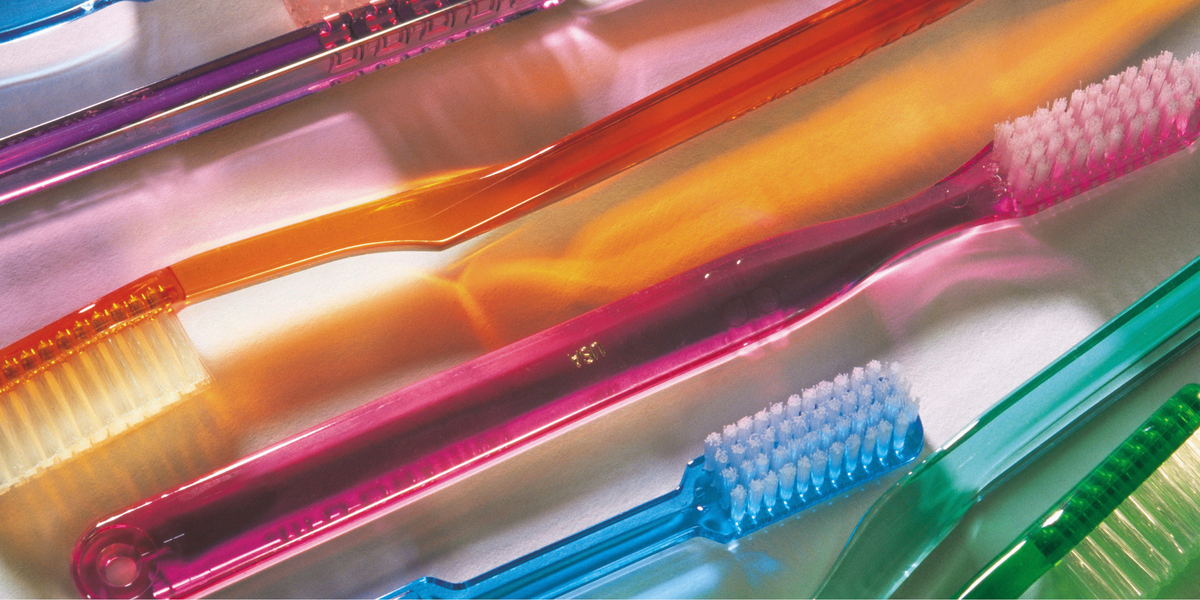
When most of us hear the word microplastics, we think about plastic bottles, food packaging, oceans, seafood, or drinking water.
We probably don't think about our toothbrush.
Or our toothpaste.
Or the piece of floss we use every day.
And chewing gum? That may be even further down the list.

Yet plastic is used throughout modern oral care from conventional plastic toothbrush handles and nylon bristles to some types of dental floss, packaging, toothpaste tubes, and synthetic materials used in certain chewing-gum bases.
So, are there actually microplastics in oral-care products, and could they end up in your mouth?
Research has detected microplastics in several categories of oral healthcare products. But there's an important distinction to understand from the start, particularly when it comes to toothbrushes:
The toothbrush research discussed in this article examined conventional 100% plastic toothbrushes not bamboo toothbrushes.
That's important because conventional plastic and bamboo toothbrushes have very different material constructions. A conventional toothbrush uses plastic throughout its handle, neck, head, grip, and bristles, whereas a bamboo toothbrush replaces one of the largest plastic components the handle with bamboo.
In this article, we'll look at what current research tells us about microplastics in oral care, where plastic commonly appears, what scientists have found so far, and practical ways to reduce plastic in your dental routine.
We'll cover:
-
Microplastics in toothpaste
-
Microplastics in dental floss
-
PFAS and PTFE in floss
-
Microplastics and synthetic materials in chewing gum
-
Research into microplastics in conventional plastic toothbrushes
-
How bamboo toothbrushes differ
-
Plant-based nylon bristles
-
Bamboo electric toothbrush heads
-
Practical ways to reduce plastic in your oral-care routine
The aim is simple: understand the materials, understand the research, and make informed choices.
Quick Answer: Can Oral-Care Products Contain Microplastics?
Yes. Microplastics have been detected in oral healthcare products in scientific research, while many conventional oral-care products also contain plastic materials by design. The amount, source, and type of plastic can vary considerably between products.
A peer-reviewed study indexed by PubMed investigated microplastics in several commercially available oral healthcare products.
Researchers examined categories including:
-
Toothbrushes
-
Toothpaste
-
Toothpowder
-
Mouthwash
-
Dental floss
-
Mouth-freshener spray
The study reported microplastic contamination across the oral-care categories examined.
Polymers identified included:
-
Polyethylene (PE)
-
Polyamide (PA)
-
Polyethylene terephthalate (PET)
-
Polybutylene terephthalate (PBT)
Among the products examined, toothbrushes had the highest reported particle count in the study's abstract, at 30–120 particles per brush.
However, there's an essential point when interpreting that number:
The toothbrushes examined in this research were conventional 100% plastic toothbrushes, not bamboo toothbrushes.
The study therefore wasn't testing MABLE bamboo toothbrushes, bamboo handles, or MABLE's plant-based nylon bristles.
It also doesn't establish whether detected particles came specifically from toothbrush bristles or the plastic toothbrush head during brushing. Understanding exactly how different components behave through normal use requires more material-specific research.
Contains Plastic vs. Microplastic Shedding vs. Microplastic Contamination
These terms can sound similar, but they describe different things.
Contains plastic means plastic is intentionally used as part of the product.
A conventional plastic toothbrush handle is a straightforward example.

Microplastic shedding refers to microscopic plastic fragments or fibers separating from a plastic material, potentially through friction, bending, wear, or other mechanical forces.
Microplastic contamination detected means testing has identified microplastic particles associated with a product or sample.
That doesn't necessarily establish exactly when, where, or how each particle entered the sample.
Understanding these differences helps put emerging research into context without assuming that every plastic-containing product behaves in exactly the same way.
Why Is There Plastic in So Many Oral-Care Products?
Plastic became common in oral care for practical reasons.
It's lightweight, inexpensive, water-resistant, flexible, durable, and easy to manufacture at scale.
Those properties have made plastic useful for:
-
Toothbrush handles
-
Toothbrush bristles
-
Floss containers
-
Toothpaste packaging
-
Dental picks
-
Interdental brushes
-
Electric toothbrush heads
-
Other bathroom products
The environmental challenge is that many of these products or components are disposable.
A toothbrush might be used for only a few months.
A floss container may be discarded once the floss runs out.
Electric toothbrush heads need regular replacement.
And toothpaste packaging eventually reaches the end of its useful life.
When these products are used by millions or billions of people, relatively small amounts of plastic per item can add up to a much larger waste stream.
Microplastic research introduces another question: what happens to these synthetic materials as they experience normal friction, bending, vibration, cutting, and wear?
Research continues to develop, making clear material information increasingly useful for consumers.
Microplastics in Toothpaste: What Should You Know?
The question “Are there microplastics in toothpaste?” sounds simple, but several different issues can sit behind it.
These include:
-
Historical use of plastic microbeads in some personal-care products
-
Microplastic contamination identified through testing
-
Plastic or polymer ingredients that may be used in formulations
-
Plastic involved in toothpaste packaging
The oral-care study discussed earlier included toothpaste among the product categories where microplastic contamination was detected.
That makes toothpaste part of the broader microplastics conversation, but formulations can vary significantly between manufacturers and individual products.
Ingredients change, manufacturing processes differ, and products are regularly reformulated.
What About Microbeads in Toothpaste?
Plastic microbeads became a major environmental concern because tiny plastic particles were intentionally added to some personal-care and cosmetic products.
Their historical use helped increase awareness around intentionally added microplastics.
When looking at toothpaste today, however, current product information matters.
Online lists showing ingredients from several years ago may no longer represent products currently being sold.
If you're concerned about a particular toothpaste, checking its current ingredient list and manufacturer disclosures gives you more useful information than relying on an older formulation.
Don't Forget the Toothpaste Tube
The toothpaste itself is only part of the plastic equation.
Conventional toothpaste packaging commonly contains plastic.
Even tubes marketed around alternative materials can contain plastic layers or components needed for product protection and dispensing.
So instead of only asking:
“Is there plastic in my toothpaste?”
It can also be useful to ask:
“How much plastic is involved in the whole product?”
That broader perspective can be applied to almost every product in the bathroom.
Are There Microplastics in Dental Floss?
Dental floss is particularly relevant to the plastic conversation because many conventional floss products are made from synthetic materials.

Traditional floss often uses nylon or PTFE-type materials, which means a plastic-based material comes directly into contact with the mouth during use.
Material composition and measurable microplastic shedding aren't necessarily the same thing, but understanding what your floss is made from is still useful if reducing plastic is a priority.
Is Traditional Dental Floss Made From Plastic?
Yes, most types are.
Common synthetic floss materials can include nylon and PTFE-type materials.
Depending on the product, coatings, waxes, flavors, and other ingredients may also be applied.
The challenge is that the material used to make dental floss isn't always obvious from the front of the packaging.
Terms such as:
“Mint floss”
or
“Smooth dental tape”
don't necessarily tell you what the strand itself is made from.
If you're trying to reduce synthetic materials in your oral-care routine, look beyond the marketing name and check the actual floss material.
What Do PFAS and PTFE Have to Do With Dental Floss?
Microplastics and PFAS are not the same issue, although both can appear in conversations about synthetic dental materials.
PTFE polytetrafluoroethylene is a fluoropolymer sometimes used to create very smooth dental tape.
PFAS refers to a much broader family of fluorinated chemicals.
Recent investigations have found some big name brands intentionally added fluorinated materials or PFAS-related compounds in certain conventional dental floss products and didn’t disclose that to customers.
Because formulations vary, the most practical approach for consumers concerned about these materials is to look for manufacturers that clearly disclose what their floss is made from and whether it is PFAS/PTFE-free.
What Is PFAS/PTFE-Free Floss?
PFAS/PTFE-free floss is dental floss made without the PTFE and PFAS materials covered by the manufacturer's claim.
The important factor is material transparency.
Instead of guessing what words such as “smooth,” “glide,” or “premium” mean, look for products that clearly identify the floss material.
For example, MABLE offers silk floss refills made from silk with plant-based candelilla wax.
MABLE's silk floss is PFAS/PTFE-free and plastic-free floss, providing an alternative to conventional synthetic floss materials.
The refills can also be paired with MABLE's refillable stainless steel floss container.
Instead of throwing away another disposable plastic floss case whenever the floss runs out, the container can be reused while replacing only the floss.
It's a good example of looking at both the material itself and the lifecycle of the entire product.
Is Silk Floss Better Than Plastic Floss?
“Better” depends on what you're trying to achieve.
If reducing plastic in your dental routine is a priority, silk floss offers an obvious material difference because the strand doesn't need to be made from conventional nylon or PTFE.
Pairing silk floss with a reusable dispenser can also reduce disposable plastic packaging.
But oral-care choices aren't universal.
People have different dental needs, budgets, preferences, allergies, ethical considerations, and recommendations from dental professionals.
A more useful question may be:
“Can I choose an effective floss that works for my teeth while using materials that better match my priorities?”
Microplastics in Floss Picks
Floss picks deserve separate attention because many combine two disposable plastic elements:
Synthetic floss + plastic handle.
Unlike a reusable floss dispenser, the entire pick is normally thrown away after one use.
For someone trying to reduce disposable plastic in oral care, switching from single-use plastic floss picks to traditional floss with a reusable dispenser can therefore address more than just the floss strand itself.
You also don't need to discard everything you currently own.
Using existing products responsibly and choosing a lower-plastic option when they need replacing can avoid creating unnecessary waste.
Microplastics in Gum: Why Chewing Gum Raises a Surprising Question
Here's one product many people don't immediately associate with plastic:
Chewing gum.

We normally think about gum in terms of flavors, mint, sugar, or sweeteners.
But chewing gum also needs something that creates its chewy structure.
That's the gum base.
Depending on the formulation, some gum bases can involve synthetic materials.
That leads to an interesting question:
Can chewing gum contain synthetic materials or release microplastics while you chew it?
The answer depends on the formulation.
Different manufacturers use different gum bases, and natural gum-base products also exist.
If you're concerned about synthetic materials in chewing gum, look for brands that provide clear information about what their gum base contains.
Terms such as “natural gum base” can be a useful starting point, particularly when the manufacturer provides additional material information.
Are There Microplastics in Toothbrushes?
Toothbrushes are particularly interesting in the emerging research around microplastics and oral care.
In the peer-reviewed study discussed earlier, toothbrushes had the highest reported microplastic particle count among the oral healthcare products examined: 30–120 particles per brush.
But the context is important:

The research examined conventional 100% plastic toothbrushes not bamboo toothbrushes.
A conventional manual toothbrush may contain:
-
A plastic handle
-
Plastic or rubber grip materials
-
A plastic neck
-
A plastic head
-
Nylon bristles
That means much of the product consisted of synthetic plastic material.
A bamboo toothbrush has a substantially different construction because the large conventional plastic handle is replaced with bamboo.
The research also doesn't establish whether every particle detected in the conventional toothbrushes came specifically from the bristles or the handle.
More material-specific research is needed to understand how different toothbrush components behave during everyday brushing.
What the existing research does highlight is the amount of plastic that can be present in a conventional toothbrush and the value of understanding the materials used in products we replace several times a year.
Can Worn Toothbrush Bristles Increase Material Wear?
All toothbrush bristles experience wear over time.
Think about what happens during several months of brushing.
Bristles repeatedly move across teeth.
They bend around gum lines.
They come into contact with toothpaste.
They're rinsed and dried hundreds of times.
Some people also bite or chew their toothbrush bristles.
Eventually, once-straight bristles become bent, frayed, or worn.
This isn't only a materials issue.
A heavily worn toothbrush may also become less effective at cleaning.
Replacing your toothbrush or brush head when the bristles are visibly worn and avoiding unnecessarily aggressive brushing are sensible habits for both brushing performance and product care.
Do Bamboo Toothbrushes Shed Microplastics?
Bamboo toothbrushes need to be considered separately from the 100% plastic toothbrushes examined in the microplastic research discussed above.
The reason is straightforward:
The bamboo handle itself isn't plastic, so the bamboo portion cannot shed plastic microplastics.

A bamboo toothbrush replaces one of the largest plastic components of a conventional toothbrush the handle with bamboo.
Most modern bamboo toothbrushes, however, still use some form of nylon bristle.
Nylon is a synthetic material, so bamboo toothbrushes with nylon bristles are more accurately described as a lower-plastic alternative rather than completely plastic-free.
Research specifically measuring microplastic shedding from different bamboo toothbrush bristle materials is still limited.
That means the 30–120 particles per toothbrush reported in research on conventional 100% plastic toothbrushes should not be applied directly to bamboo toothbrushes.
The products have different material constructions and need to be evaluated accordingly.
What Are Plant-Based Nylon Toothbrush Bristles?
The term “plant-based nylon” can initially sound confusing.
If something is plant-based, does that mean it's automatically biodegradable?
Not necessarily.
MABLE's toothbrush bristles use plant-based nylon derived from castor bean oil.
Using a plant-derived feedstock can reduce reliance on conventional petroleum-based inputs.
However, the resulting bristle material remains a form of nylon.
For that reason, MABLE's plant-based nylon bristles aren't considered:
-
Biodegradable
-
Compostable
-
Home compostable
The distinction comes down to the difference between where a material begins and how the finished material behaves.
“Plant-based” describes the origin of some of the material input.
It doesn't necessarily mean the finished material will break down like untreated bamboo, paper, or other naturally compostable materials.
What Do We Know About MABLE's Plant-Based Nylon and Microplastics?
There is currently limited product-specific research measuring microplastic shedding from MABLE's particular plant-based nylon bristles during normal brushing.
And the conventional toothbrush research discussed earlier doesn't answer that question because the toothbrushes studied were 100% plastic toothbrushes, not MABLE bamboo toothbrushes.
MABLE has asked its manufacturer about the bristle material.
According to the manufacturer, the filament grade is FDA approved for safety and the filaments are subject to “normal wear”. The manufacturer has also stated that the castor-bean-based bristles do not contain plasticizers or hormone disruptors.
Like other toothbrush bristles, the filaments will gradually experience wear through regular use.
What remains an area for further research is how different bristle materials behave at the microscopic level during months of real-world brushing and whether shedding differs between materials.
For now, the clearest material difference is that a MABLE toothbrush replaces the conventional plastic handle with bamboo while using plant-based nylon for the bristles.
Are Bamboo Toothbrush Bristles Compostable?
The nylon bristles used in most bamboo toothbrushes including MABLE's plant-based nylon bristles aren't compostable.
The bamboo handle and bristles therefore need to be considered separately at the end of the toothbrush's useful life.
The bamboo handle represents the major material change compared with a conventional plastic toothbrush handle.
Before disposing of the bamboo portion according to appropriate local composting or waste guidelines, the nylon bristles can be removed and placed in regular waste.
That provides a more accurate picture of what a bamboo toothbrush is: a significant reduction in conventional plastic rather than a completely compostable toothbrush.
How Much Plastic Can a Bamboo Toothbrush Reduce?
A conventional toothbrush can contain plastic throughout its handle, neck, head, grip, and bristles.
Replacing the large handle with bamboo removes one of the biggest plastic components.
That's why switching to a MABLE bamboo toothbrush can represent a meaningful lower-plastic change even though nylon remains in the bristles.
MABLE offers several options, including:
This is another reason the distinction between bamboo and conventional toothbrushes matters when discussing microplastic research.
The available study reporting microplastic particles in toothbrushes examined 100% plastic toothbrushes. Bamboo toothbrushes have a different material composition because the conventional plastic handle is replaced with bamboo.
For MABLE, the sustainability benefit is straightforward: a substantial conventional plastic component is replaced with bamboo while the remaining nylon bristles are clearly identified.
What About Bamboo Electric Toothbrush Heads?
Electric toothbrushes introduce a slightly different sustainability challenge.
The main electric toothbrush body may remain in use for years, but replacement brush heads are repeatedly discarded.
Traditional electric brush heads typically use a significant amount of plastic in their base.
MABLE's bamboo electric toothbrush heads replace much of that conventional plastic base with bamboo.
Options include:
These replacement heads still use nylon bristles, so they're best understood as lower-plastic rather than completely plastic-free.
The conventional 100% plastic toothbrush study discussed earlier didn't test MABLE's bamboo electric toothbrush heads, so its particle counts aren't measurements of these products.
The more direct sustainability benefit comes from replacing much of the conventional plastic base in a component that needs to be replaced regularly.
Are Animal-Hair Toothbrush Bristles a Plastic-Free Alternative?
Animal-hair bristles are sometimes considered by people looking for toothbrushes without nylon.
Depending on the construction, they can reduce or eliminate synthetic bristle materials.
But they come with other considerations.
Animal hair may be considerably firmer than modern soft toothbrush filaments. There can also be hygiene, odor, taste, sourcing, vegan, and animal-welfare considerations.
Sustainability decisions often involve trade-offs between:
-
Materials
-
Hygiene
-
Durability
-
Performance
-
Ethics
-
Comfort
The lowest-plastic option isn't automatically the right oral-care product for every person.
How to Reduce Plastic in Oral Care Without Throwing Everything Away
Learning how much plastic can appear in everyday products may make you want to replace everything in your bathroom immediately.
But creating unnecessary waste isn't the goal.
If something you already own is safe, functional, and still within its useful life, a more practical approach is:
Use what you have responsibly, then make a more informed choice when it's time for replacement.
1. Check What Your Dental Floss Is Made From
Look beyond the product name and check the actual floss fiber.
If reducing synthetic materials matters to you, consider alternatives such as MABLE silk floss, made without PFAS or PTFE.
2. Replace Disposable Floss Cases With a Reusable One
The floss itself isn't the only source of disposable material.
A reusable stainless steel floss dispenser can be refilled rather than thrown away whenever the floss runs out.
3. Consider a Bamboo Toothbrush When Yours Needs Replacing
When your existing toothbrush reaches the end of its useful life, switching from a conventional plastic handle to a bamboo toothbrush can remove a substantial plastic component from your routine.
Most modern bamboo toothbrushes still use nylon bristles, so think of this as reducing plastic rather than eliminating it completely.
4. Consider Bamboo Replacement Heads for Electric Toothbrushes
You don't necessarily need to stop using an electric toothbrush to reduce plastic.
If you already have a compatible electric toothbrush, a bamboo electric toothbrush head can replace much of the conventional plastic used in the component that is regularly discarded.
5. Replace Worn Bristles
Keeping a toothbrush indefinitely isn't an effective way to reduce waste.
Once the bristles become heavily frayed, bent, or worn, it's appropriate to replace the toothbrush or brush head.
6. Brush Gently
More pressure doesn't necessarily mean cleaner teeth.
Appropriate brushing technique can help protect your gums and teeth while avoiding unnecessary wear on your toothbrush.
Follow your dental professional's advice for brushing technique and oral care.
7. Look Beyond “Eco” Marketing
Words such as:
Eco-friendly
Green
Natural
Plant-based
Sustainable
can be useful, but they don't tell the entire story.
Ask more specific questions:
What is the handle made from?
What are the bristles made from?
What material is the floss?
Does it contain PTFE?
Can the container be reused?
Which components are actually compostable?
Specific material information can tell you much more than a broad sustainability claim.
Plastic-Free vs. Lower-Plastic: What's the Difference?
This distinction is particularly important in sustainable oral care.
Plastic-Free
A genuinely plastic-free product doesn't contain plastic in the components covered by that claim.
Lower-Plastic
A lower-plastic product still contains some plastic but removes or replaces a meaningful portion of what would normally be plastic.
A bamboo toothbrush with nylon bristles is a good example.
Plant-Based Plastic
Plant-based plastic uses renewable biological feedstocks for some or all of its raw material input.
That doesn't necessarily mean the finished material is biodegradable or compostable.
Compostable
A compostable material is designed to break down under specified composting conditions.
Not every plant-based material is compostable.
PFAS/PTFE-Free
This describes the absence of the particular fluorinated materials covered by the product's claim.
It doesn't automatically mean that the entire product is plastic-free.
Understanding these terms makes it much easier to compare oral-care products based on their actual materials rather than broad marketing language.
Where Does MABLE Fit Into Lower-Plastic Oral Care?
At MABLE, the focus is on replacing substantial disposable plastic components where practical while being clear about the materials that remain.
For flossing, that means PFAS/PTFE-free silk floss paired with a reusable stainless steel dispenser.
For manual brushing, it means replacing the conventional plastic toothbrush handle with bamboo through products such as:
For people who already use electric toothbrushes, bamboo electric toothbrush heads replace much of the conventional plastic head or base with bamboo while retaining nylon bristles.

MABLE bamboo toothbrushes aren't completely plastic-free because the plant-based nylon bristles remain a form of nylon.
Instead, they're designed as a lower-plastic alternative that replaces one of the largest conventional plastic components the handle with bamboo.
For someone trying to create a lower-plastic dental routine, replacing some of the largest and most frequently discarded plastic components can be a practical place to begin.
The Bottom Line: Should You Worry About Microplastics in Oral Care?
Microplastics in oral-care products are a legitimate and developing area of scientific research.
A peer-reviewed study has detected microplastics across several oral healthcare product categories, including toothbrushes, toothpaste, dental floss, and other products.
When it comes specifically to toothbrushes, there's one distinction worth remembering:
The toothbrush research discussed in this article examined conventional 100% plastic toothbrushes not bamboo toothbrushes.
The reported 30–120 particles per toothbrush therefore shouldn't be treated as a measurement of MABLE's bamboo toothbrushes or bamboo electric toothbrush heads.
There are still important questions for researchers to explore, including how individual toothbrush materials behave through normal use and whether different bristle materials release different amounts of microscopic particles as they wear.
For consumers, the practical approach is simpler.
Understand what your oral-care products are made from.
Reduce unnecessary disposable plastic where practical.
Look for transparent material information.
Consider bamboo handles or bamboo replacement heads when your existing toothbrush needs replacing.
Choose reusable options where they make sense.
And remember that lower-plastic can still represent meaningful progress even when completely plastic-free isn't practical.
When it's time to replace products you already use, explore MABLE's lower-waste oral-care products and choose options that make sense for your routine.
Frequently Asked Questions About Microplastics in Oral Care
Are There Microplastics in Oral-Care Products?
Yes. Microplastics have been detected in commercially available oral healthcare products in peer-reviewed research. Studies have examined categories including toothbrushes, toothpaste, toothpowder, mouthwash, dental floss, and mouth-freshener spray.
The source and amount can vary between products and materials.
Are There Microplastics in Toothpaste?
Microplastic contamination has been reported in toothpaste in research examining oral healthcare products.
However, formulations differ between manufacturers and individual products. If you're concerned about a particular toothpaste, check its current ingredient list and manufacturer disclosures.
Are There Microplastics in Dental Floss?
Many conventional dental floss products use synthetic materials such as nylon or PTFE-type materials.
The presence of synthetic material and measurable microplastic shedding aren't necessarily the same thing, so checking the actual material used in a particular floss is useful.
Is Traditional Dental Floss Made From Plastic?
Many conventional floss products use synthetic fibers such as nylon or PTFE-type materials.
Product materials vary, so check the manufacturer's disclosures if you want to know exactly what a particular floss contains.
What Is PFAS-Free Floss?
PFAS-free floss is sold with a claim that the relevant PFAS materials aren't intentionally used in the product.
MABLE's silk floss, for example, is made without PFAS or PTFE and uses silk with plant-based candelilla wax.
Does Chewing Gum Contain Microplastics?
Some chewing-gum formulations can use synthetic materials in their gum base, while other products use natural gum bases.
Because formulations differ, checking the manufacturer's current material and ingredient information is the best way to understand a particular product.
Are There Microplastics in Toothbrushes?
Microplastics have been detected in toothbrushes in published research.
One oral healthcare product study reported 30–120 particles per toothbrush.
Importantly, the toothbrushes examined in this research were conventional 100% plastic toothbrushes not bamboo toothbrushes.
The findings therefore shouldn't be interpreted as testing of MABLE bamboo toothbrushes.
Do Bamboo Toothbrushes Shed Microplastics?
The bamboo handle itself isn't plastic, so it cannot shed plastic microplastics.
Most bamboo toothbrushes do, however, use nylon bristles.
Research specifically measuring microplastic shedding from different bamboo toothbrush bristle materials remains limited, and findings from studies of conventional 100% plastic toothbrushes can't simply be applied to bamboo toothbrushes.
Are MABLE Bamboo Toothbrushes Plastic-Free?
MABLE's bamboo toothbrushes are best described as lower-plastic rather than completely plastic-free.
The conventional plastic handle is replaced with bamboo, while the bristles use plant-based nylon derived from castor bean oil.
What Is Plant-Based Nylon?
Plant-based nylon is nylon produced using renewable biological feedstocks for some of its raw material input.
MABLE's bristles use nylon derived from castor bean oil. This reduces reliance on conventional petroleum-based feedstocks, but the finished material remains a form of nylon.
Are Bamboo Toothbrush Bristles Compostable?
MABLE's plant-based nylon bristles aren't compostable or biodegradable.
The bristles should be considered separately from the bamboo handle when disposing of the toothbrush at the end of its useful life.
Do Bamboo Electric Toothbrush Heads Contain Plastic?
MABLE's bamboo electric toothbrush heads replace much of the conventional plastic base with bamboo, but they still use nylon bristles.
They're therefore better described as lower-plastic rather than completely plastic-free.
How Can I Reduce Plastic in My Dental Routine?
Start with practical changes when existing products need replacing.
Consider bamboo toothbrush handles, bamboo electric replacement heads, silk floss, reusable floss dispensers, and products with clear material information.
The goal doesn't have to be eliminating every piece of plastic at once. Reducing some of the largest and most frequently discarded plastic components can still make a meaningful difference.
Should I Stop Using My Current Toothbrush Because of Microplastics?
The research discussed here doesn't mean you need to immediately discard a functional toothbrush.
Continue following appropriate oral-hygiene guidance and replace your toothbrush or brush head when it becomes worn.
When replacement time comes, you can consider a lower-plastic alternative if it fits your needs and priorities.
A More Informed Approach to Oral Care
Research into microplastics will continue to develop as scientists learn more about how microscopic particles enter products, how different materials behave during use, and what those findings mean for everyday exposure.
For toothbrushes, one distinction is particularly important when looking at the research available today:
Studies involving conventional 100% plastic toothbrushes and their reported microplastic particles aren't studies of bamboo toothbrushes.
Bamboo handles remove a substantial conventional plastic component, while nylon bristles remain and should be considered separately.
A practical approach to lower-plastic oral care doesn't require perfection.
Understand the materials. Reduce unnecessary plastic. Choose reusable options where practical. Use what you already own responsibly. And make better-informed choices when it's time for a replacement.
That's a realistic path toward a lower-plastic bathroom without making the issue more complicated or more alarming than the available research supports.

Share:
How MABLE Gives Back: Our Buy Give Teach Donation Model